
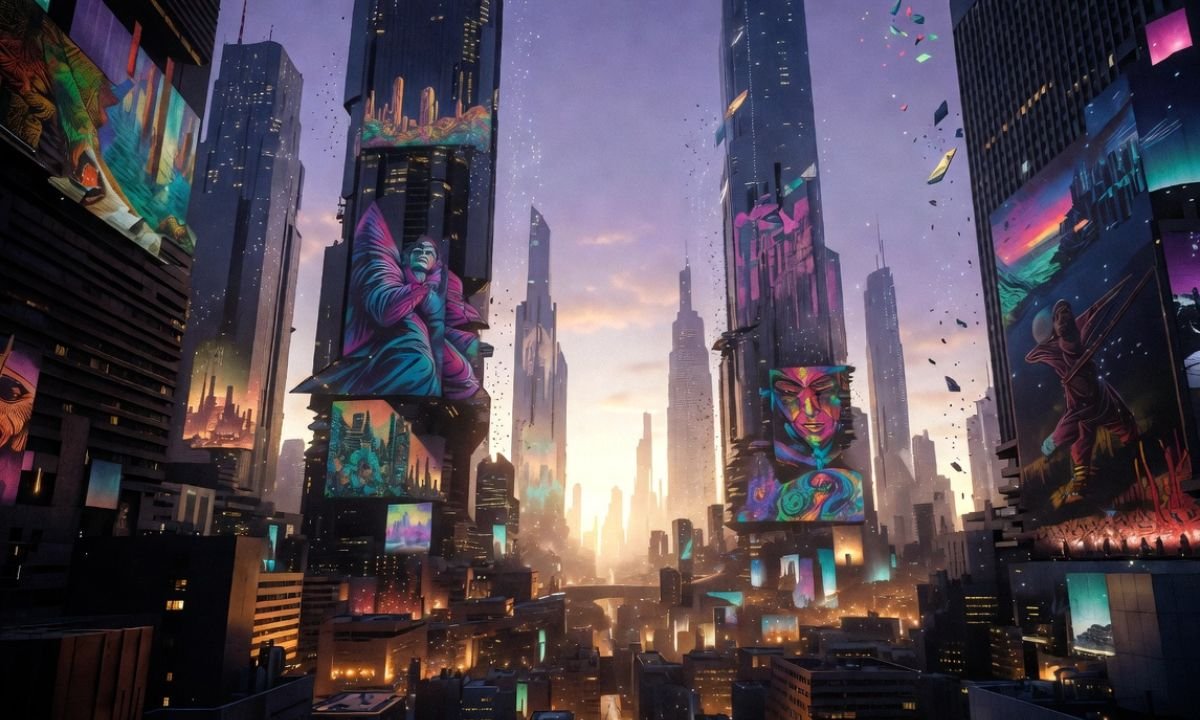
Imagine a mural stretched across a rain-streaked skyscraper in a city that never sleeps. Its colors bleed deliberately into the concrete below, figures dissolving as if the work itself refuses to be owned. This is the premise of Ephemeral Cities, a conceptual practice where artists design urban interventions meant to disappear, leaving behind only documentation, memory, and the quiet question of what value lingers once the physical piece is gone. In an art world that once prized permanence, such work captures something essential about our time: transience as both subject and strategy. For artists today, the same paradox offers a blueprint. The very qualities that make art fleeting, intimate, or hard to pin down can become the foundation for sustainable income when translated thoughtfully into the digital sphere.
The global art market rebounded in 2025, reaching 59.6 billion dollars in sales, yet online channels now represent a more measured but still vital slice of the pie. In the United States alone, online art sales are projected to stabilize around 4.2 billion dollars in 2026. What has changed is not the desire to buy art but the expectations around how it reaches collectors: directly, narratively, and often without the mediation of a white-cube gallery. For emerging and mid-career artists, especially those working outside traditional centers or exploring ideas of impermanence, this shift levels the field. It rewards clarity of vision, consistency of voice, and the ability to turn process into product without compromising soul.
Crafting an Authentic Digital Identity
Before any sale, there must be recognition. The most successful artists online treat their digital presence as an extension of the studio rather than a marketing afterthought. A personal website remains the most powerful tool, offering full control over pricing, narrative, and customer relationships. Platforms such as Shopify allow seamless integration with print-on-demand services like Printful or Printify, turning original concepts into accessible editions without inventory headaches.
Social media, particularly Instagram and TikTok, still serves as discovery engine, but the algorithm favors depth over volume. Short videos documenting the slow erosion of a mural in Ephemeral Cities, time-lapse sequences of pigment meeting weather, or reflections on why disappearance matters culturally outperform polished product shots. Collectors in 2026 crave the human hand and the story behind it, especially when artificial intelligence floods marketplaces with flawless but rootless imagery. Authenticity becomes the quiet differentiator.
Choosing Platforms That Align with Your Practice
No single marketplace fits every artist. Etsy remains an accessible entry point for prints, small originals, and handmade goods, with its built-in traffic and relatively low barriers. Saatchi Art caters to those seeking serious collectors, taking a 35 percent commission but offering editorial features and global reach. For artists drawn to conceptual work like ephemeral murals, Fine Art America or Society6 excel at turning digital files into wall-ready reproductions or merchandise.
The most sustainable model often combines several: an independent Shopify store as home base, curated listings on Saatchi for prestige, and Etsy for steady print sales. Artists working with transient ideas frequently sell layered offerings: high-resolution digital editions of the mural documentation, limited physical prints capturing the work mid-dissolution, or even NFTs of the vanishing process for those drawn to blockchain permanence. Diversification protects income while letting the core concept breathe across formats.
Storytelling as the Real Currency
Price alone rarely closes a sale. What moves collectors is context. In the Ephemeral Cities series, each mural begins with a site-specific proposal tied to local histories of displacement or renewal. The documentation, therefore, carries philosophical weight: photographs taken at precise hours, essays on impermanence drawn from Buddhist notions of anicca or Latin American traditions of public ritual. When shared online, these elements transform a simple image into an invitation.
Artists who succeed treat captions, emails, and studio updates as extensions of the work itself. A monthly newsletter might share the next city targeted for disappearance, the technical challenges of weather-proof pigments, or the quiet grief of watching hours of labor wash away. Such transparency builds community and justifies premium pricing. Collectors do not simply acquire an object; they participate in an ongoing conversation about time, memory, and what we choose to preserve.
Pricing with Intention and Flexibility
Pricing remains one of the most misunderstood aspects of selling online. Start by calculating true costs: materials, time, studio overhead, and platform fees. Then layer in market positioning. A digital edition of an Ephemeral Cities mural might begin at a few hundred dollars, while a signed physical print capturing the final moments commands more. Original small studies or preparatory sketches often sell faster and fund larger, riskier projects.
Tiered offerings help. Many artists now offer open editions via print-on-demand for accessibility, limited signed runs for mid-level collectors, and unique pieces reserved for direct studio sales or gallery partnerships. Transparency matters. Clearly stated shipping policies, return options, and certificates of authenticity reassure buyers who may never meet the artist in person. International sales, particularly to diaspora communities from South Asia, Africa, or Latin America, have grown steadily; tools like Printful handle global fulfillment, removing one of the biggest logistical barriers.
Marketing That Resonates Across Borders
Effective promotion today looks less like advertising and more like cultural contribution. Artists in emerging markets leverage online platforms to reach collectors in Europe or North America who share cultural roots but lack local access. A mural series addressing urban erasure in Lahore or Lagos can resonate with collectors worldwide precisely because its documentation travels instantly. Collaborations with cultural institutions, features in independent magazines, or guest curations on platforms like Artsy amplify reach without heavy spending.
Search-engine visibility also plays a quiet but decisive role. Blog posts on a personal site, optimized around phrases such as sustainable art practices or conceptual mural documentation, draw organic traffic from curious browsers. Over time, these evergreen pieces compound, turning one-time visitors into long-term supporters.
Protecting Your Work and Sustaining Your Practice
Copyright remains essential. Watermarking previews and registering key works provides peace of mind, though the most effective protection is often community vigilance and clear licensing terms. For ephemeral concepts, contracts with buyers of digital files can specify usage rights while preserving the artist’s moral rights to the idea.
Perhaps the deepest challenge is protecting creative energy amid commercial demands. The artists who endure treat commerce as support for practice rather than its definition. They set boundaries around studio time, batch social-media content, and occasionally step away to let new ideas surface in silence. In this balance lies the quiet triumph: art that disappears on its own terms still finds homes, still generates income, and still sparks reflection long after the last pigment has faded.
The Ephemeral Cities series reminds us that value does not require permanence. It requires presence, intention, and the courage to let go at the right moment. For artists willing to translate that philosophy into digital strategy, the online world offers more than transactions. It offers a global stage where transience itself becomes the most enduring form of connection. In learning to sell with integrity, artists do not merely make money. They keep the conversation alive, one disappearing mural, one thoughtful collector, at a time.